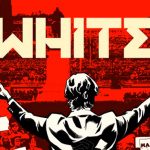

There are often movies that evoke a visceral emotion in me. Something that causes me to connect with the content in such a way that I sometimes need to take a moment afterwards and process what I just watched. Paint is one of those films.
Written and directed by Mora Carew (Before Sunrise, The Piano, 2 Eye Drops for Normal), Paint tells the story of an artist named Julian (Vincent Washington), and the personal struggles that he’s dealing with. From the film’s summary, “A brilliant but disturbed artist struggles to connect with his audience.” The short film has made the rounds at festivals worldwide, garnering awards and nominations. Some of these wins include the Miami International Science Fiction Film Festival (2025 Winner, Best Actor, Short/ Vincent Washington) and the Albuquerque Film Festival (2025 Winner, Jury Award/ Best Short Drama).

In this surrealist short film, we’re introduced to Julian, a struggling artist living with his sister, Alanna (played by Kayla Green). To put it bluntly, Julian is going through it. He’s struggling to come up with a new idea for an art piece that will be his first featured work for a residency he’s been accepted to. This isn’t simply a case of “artist’s block”. Julian is dealing with mental health issues.
With her script and direction, Carew expertly weaves in various context clues through dialogue between Julian and Alanna, and Julian’s actions, suggesting that there’s more that Julian is dealing with than simply trying to find inspiration for a new art piece.
We see the internal battle waging in the artist through simple facial tics, frustrated discussions with his caring sister, and an apparent lack of motivation to do anything. Anxiety, depression, self-loathing, and doubt all coalesce within Julian throughout the short film, highlighting his struggles. This is a lot for one actor to handle, and Washington does so with great care. This speaks to Carew’s deft direction, finding ways to create a nuanced and tactful exploration of someone grappling with their mental health.

And the honest and spot-on portrayals don’t just stop with Washington. Kayla Green, as Alanna, does a great job of capturing the frustration and resilience of someone dealing with a loved one who deals with the issues that Julian is contending with. She cares for him, but you also get the feeling that she’s tired. It’s been years of seeing her brother tackling his emotional challenges, and in this short film, it seems as if things eventually hit their fevered pitch.
Another notable performance is that of Taylor Cannon, who portrays Crystal, Julian’s former girlfriend. From the duo’s brief interaction, Crystal puts a spotlight on the effects that being in a relationship with someone dealing with such personal demons might have on such a partnership. After a chance encounter between the two, there’s hesitancy from Crystal to consider moving things further than a simple date. With all three of these performances, Carew gives us a very balanced look into how such emotional challenges have on people of color, specifically African Americans. Although popular media has improved in addressing topics such as this for this demographic, having a piece like Paint, which directly tackles mental illness struggles, is greatly appreciated.
And this is where Paint works best. Highlighting the internal (and eventually physical) struggle that Julian grapples with. Within sixteen minutes, Carew and her cast/ crew shine a well-constructed light on the trials of someone doing their best to cope and simply exist, while their mental weight threatens to tear them down.

The film is shot beautifully, bringing to mind such recent television shows as Insecure and Forever. This feels like a love letter to LA in many instances, which I enjoyed.
What’s interesting is that the speculative fiction aspect of this surrealist short doesn’t really make itself known until the final moments of the film. And even then, that ending feels a little abrupt coming as an escalation of Julian’s troubles. One thing that I will suggest is that there should be a trigger warning assigned to the film focusing on depictions of suicide, self-injury, and mental health struggles. Because when the film reaches its final minutes, there’s a lot to take in.
And ultimately, that might be the point with Paint. There’s often no easy way to tackle struggles with mental wellness. In very stark terms, Paint captures that perfectly and a bit harshly.
Robert Jeffrey II is an award-winning/ nominated professional writer (comic books, video games, tabletop gaming, prose fiction, and journalism) with over 20 years of experience as a creative writer. He has worked with clients such as DC Comics, the Centers for Disease Control, Son of Oak Gaming, 133Art Publishing, RAE Comics, SUBSUME Media, New Agenda Publishing, MV Media, BlackSci-Fi.com, and Nitto Tires. He is a graduate of the 2017 DC Comics Writers Workshop Class, and recently worked as a video game writer for developer Blowfish Studios on such projects as Shadowman: Darque Legacy and Phantom Galaxies. You can find him at www.robertkjeffrey.com and on IG at robertk.jeffrey.