
In this engaging interview with Milton Davis, we dive deep into the creative mind behind “Spacefunk,” exploring the inspirations, challenges, and remarkable stories that shaped this groundbreaking anthology. From the influence of African astronomy to the legacy of Hidden Figures and Black astronauts, the interview offers a fascinating look at how Afrofuturism and the voices of the African Diaspora intertwine in the realm of speculative fiction. Get ready to uncover the passion and vision driving this unique project!

BlackSci-Fi: What inspired you to create “Spacefunk” and how did you come up with the concept?
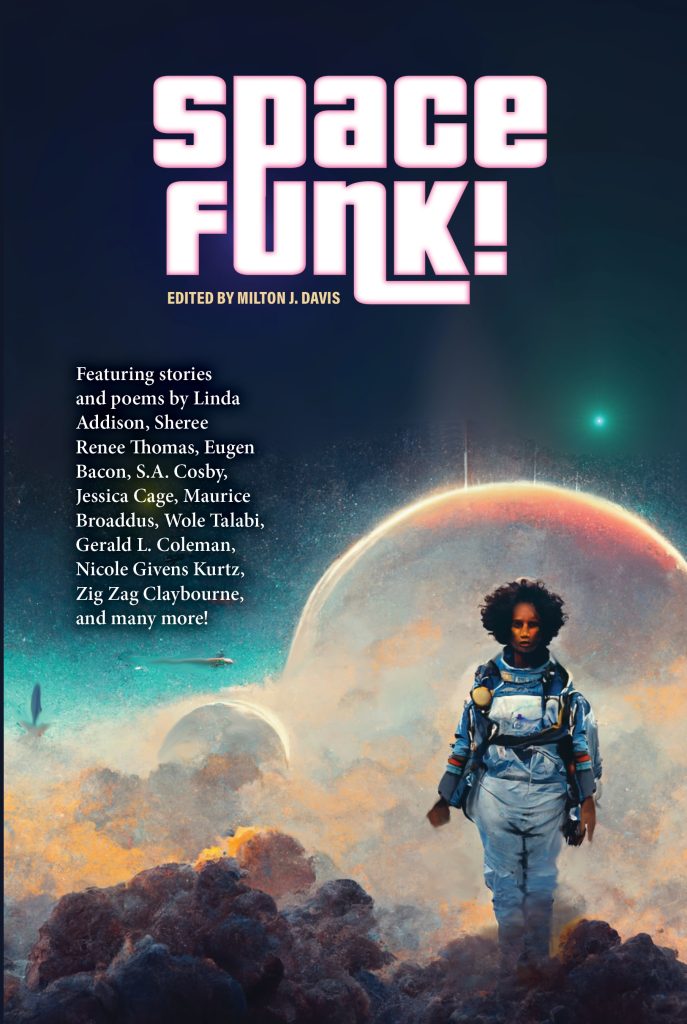
Milton Davis: The inspiration was somewhat practical. When I opened the submissions for Cyberfunk I received a number of good stories that didn’t fit the cyberfunk/cyberpunk description. The majority of them were space stories, and that’s where the idea came from. I asked the authors if I could hang on to their stories until I could pull the next anthology together. That’s how it all began.
BSF:How do you see the influence of ancient African astronomy and cosmology in modern science fiction?
MD: I think we’re still exploring that possibility. The most discussed is Dogon culture and their connection with Sirius B. There’s also the connection to Kemet/Nubian culture, and more recently Yoruba culture. Overall, I don’t see much influence, but I know that’s changing.
BSF: How did the achievements of the Hidden Figures and Black astronauts shape your vision for “Spacefunk”?
MD: In the Spacefunk intro ‘What is Spacefunk?’ I refer to those amazing sisters. Their achievements and those of other Black people involved in all aspects of Space travel act as validation for the anthology. I wanted people to know that we have always been involved in Space and what they’re reading in this anthology is a continuation of that legacy.
BSF:What role does Afrofuturism play in your anthology, and how do you incorporate elements of it into your stories?
MD: It depends on the author. We received stories that covered the range of Black Speculative Fiction. There are quite a few that are strictly Afrofuturism, and some that are space opera and more. I think that’s what makes this anthology so engaging.
BSF: How do you balance historical accuracy with creative storytelling in “Spacefunk”?
MD: Again, it’s based on the authors. In this anthology historical accuracy wasn’t a high priority. I was most interested in the authors’ vision. The story that comes closest would be The Right Stuff by Lynette S. Hoag. It takes place in an alternate 1960’s America.
BSF: What message do you hope readers take away from the anthology?
MD: No particular message. I just want readers to enjoy the stories and the variety and diversity of the authors. The purpose of the Funk anthologies has been to let African/African Diaspora authors express themselves their way in speculative genres that haven’t always been open to them. Spacefunk continues the purpose.
BSF: Tell us about the contributors to Spacefunk?
MD: The best thing about doing the Funk anthologies has been the variety of authors. We have veteran authors and poets like Linda Addison, Sheree Renee Thomas, Nicole Givens Kurtz, and Maurice Broaddus, and we have first time published authors like Rob Grimoire and Nepurko Keiwu. We also have cross genre authors like S.A. Cosby, Jessica Cage, and Antoine Bandele. And then we have international authors like Eugen Bacon (Tanzania/Australia), Tonya Moore (Jamaica), Wole Talabi (Nigeria), Makeda Braithwaite (Guyana), and Oghan N’Thanda (Brazil). Africa and the African Diaspora is well represented.
BSF: How did you select the authors and poets featured in “Spacefunk”?
MD: It’s simple. I choose what I like. I know many of the authors personally, but there are always a few authors who I’m reading for the first time. For me it’s not about who I think will be the most marketable, it’s all about the story.
BSF: Can you share any behind-the-scenes stories or challenges you faced while creating Spacefunk?
MD: The biggest challenge for Spacefunk was its size. I’ve never published a book with so many authors. It magnified every aspect of book making, as well as keeping up with the authors and stories.
BSF: What are your future plans for “Spacefunk” and do you have any upcoming projects in the works?
MD: We just completed the hardback edition for the book and will eventually do an audiobook version. There are a few more related projects I’m working on, but we’re keeping them secret right now until they are closer to completion. As far as MVmedia is concerned, we’re working on Terminus Three, our Atlanta themed speculative fiction anthology, and Playing The Odds Episode Two, the continuation of the animated series based on my novella of the same name.
MVmedia, LLC
Publishing and Beyond
Afrofuturism, Sword and Soul, Steamfunk and more!